
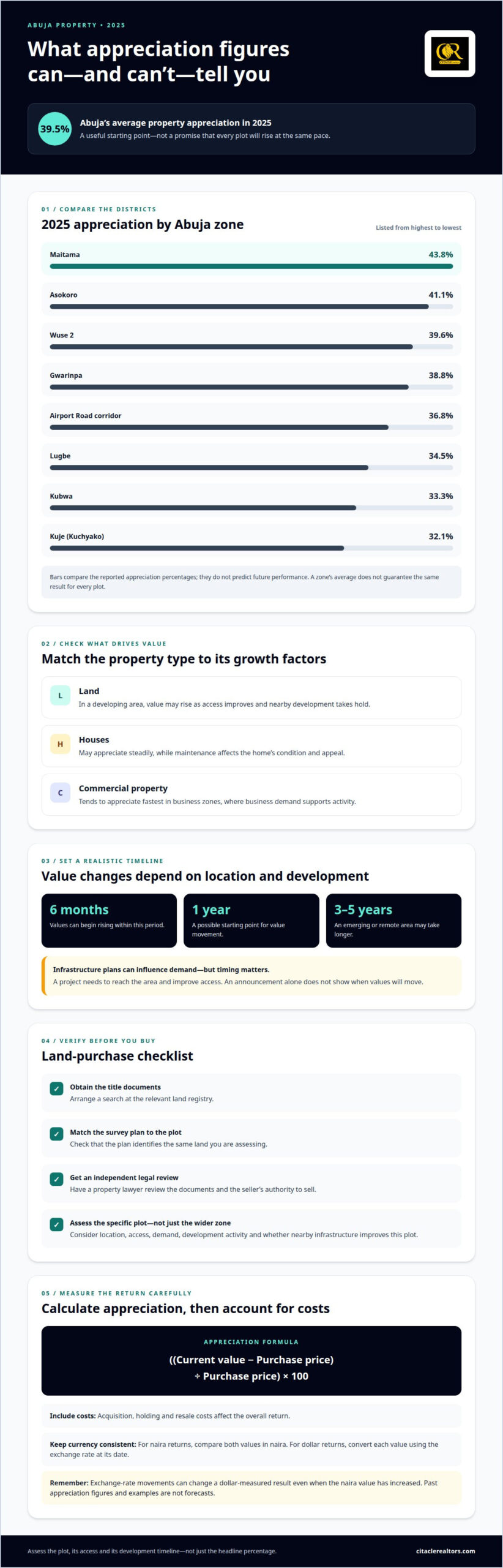
Abuja property appreciated by an average of 39.5% in 2025, with Maitama at 43.8% and Asokoro at 41.1%. These figures give a useful starting point for understanding land appreciation rates in Nigeria, but they don’t mean every plot in a high-performing zone will rise at the same pace. The location, access and timing of nearby development all matter.
It makes sense to look beyond a headline percentage when deciding whether to buy land: an established district may have strong past growth, while an emerging area may offer a different entry point and a longer wait for development to take hold. This guide explains which Abuja zones recorded the strongest appreciation, what the figures can and can’t tell you about real estate as an investment, and how buying early in a developing area may shape your decision. You’ll also see what to weigh when comparing growth corridors, so you can assess an opportunity with a clearer view of both its potential and its timeline.
Key Takeaways
- Compare Abuja zones by their 2025 performance: Maitama and Asokoro led the listed areas, while several outer zones also recorded growth.
- Choose a property type with its trade-offs in mind: land may gain value quickly in growing areas, houses need maintenance, and commercial property is tied to business activity.
- Assess infrastructure plans and development activity around a plot; early buying can mean a longer wait before an emerging area attracts stronger demand.
- When comparing Abuja with other Nigerian cities, focus on local growth drivers and timelines rather than assuming one city’s performance predicts another’s.
Abuja Property Appreciation Rate 2026: Which Zones Are Growing Fastest?
Abuja property appreciated by an average of 39.5% in 2025. Maitama led with 43.8%, followed by Asokoro at 41.1%. Wuse 2 recorded 39.6%, Gwarinpa 38.8%, and the Airport Road corridor 36.8%. Lugbe reached 34.5%, Kubwa 33.3%, and Kuje (Kuchyako) 32.1%. These differences show why the district matters when assessing residential demand and recent annual appreciation.
Land, houses, and commercial property respond to different growth drivers. Land in a developing area may gain value as access and nearby development improve. Houses can appreciate steadily, but maintenance affects their condition and appeal. Commercial property tends to appreciate fastest in business zones, where demand from businesses supports activity.
Property values in Nigeria can begin rising within 6 months, 1 year, or 3-5 years, depending on location and development plans. A fast-developing zone may show movement sooner; an emerging or remote area may take longer. Government infrastructure plans can influence demand, but the timing depends on development reaching the area.
To verify a land title and reduce fraud risk, obtain the title documents and arrange a search at the relevant land registry. Check that the survey plan identifies the same plot, and have an independent property lawyer review the documents and the seller’s authority to sell.
Calculate appreciation by subtracting the purchase price from the current value, then dividing by the purchase price and multiplying by 100. These are examples, not forecasts; expected returns depend on resale value and holding costs.
For returns measured in naira, compare the purchase and resale values in naira. For returns measured in dollars, convert both values using the relevant exchange rates at each date. Exchange-rate movements can change the result, even when the naira value has increased.
Land appreciation rates in Nigeria vary with location, access, demand, and development. Ask for clear information and proper documentation, and assess the plot itself rather than relying on promised growth.
Is Abuja real estate a good investment in 2026?
Abuja’s investment case depends partly on population growth and infrastructure delivery. The city’s population is growing at 6.4% annually, increasing demand for homes and services. Nigeria’s real estate market is forecast to grow at a compound annual growth rate of 3.15% from 2026 to 2031. These are broad market indicators, not a return forecast for a particular plot or estate.
Infrastructure can make land more useful and attractive to buyers. A completed road can improve access to workplaces, services, and nearby housing. In comparable FCT zones, infrastructure completion has historically been followed by 15-25% appreciation within 12 months. The effect depends on whether a project improves access to the specific corridor, rather than simply being announced nearby.
Development activity can affect when values change. Construction, utilities, and rising residential demand may attract more buyers. A plot with active development nearby may be easier to use or resell than land with limited access and services. Assess how development affects the specific plot, not just how close it appears on a map.
For a Nigerian land purchase or sale, applicable taxes and statutory charges depend on the state and transaction. Registration, title documentation, legal work, and surveying can also add to transaction costs. Requirements vary with the property and transaction.
Key risks include disputed ownership, poor access, delayed infrastructure, and limited resale demand. Holding land also ties up capital while development progresses. Purchase and resale values alone do not show your full return, so include acquisition and holding costs in your calculations.
Improvements may make a plot more practical and appealing. Clearing, fencing, or securing a farm project can support resale value by making land more usable and visible. Choose improvements that suit the land’s intended use and the development around it.
Assess Abuja property by weighing growth drivers against ownership, access, and holding costs. That gives a more useful investment decision than relying on a national forecast or infrastructure announcement alone.
Buying land early in developing areas
Buying land before an area is fully built up can provide an earlier entry point, but appreciation depends on development reaching the plot. In developing parts of Lagos, land may appreciate by 10% to 30% yearly when development is active. The strongest parts of Ibeju-Lekki and Sangotedo are projected to record cumulative property price growth of about 80% to 130% over five years. These figures point to potential, not a guaranteed outcome for every parcel.
Land banking means buying land, holding it for a few years, then reselling when demand rises. That strategy requires patience and a clear view of what could bring buyers to the area, such as roads, estates, or expanding services. Epe offers a cautionary example: a buyer who purchased land there in 2021 had been told it would double in one year, but three years after purchase, its price had barely changed.
Before buying, consider how development connects to the specific plot. Assess whether active construction, improved access, or nearby housing could make it more useful. Growth across a wider corridor matters to a particular parcel only if it improves access or brings demand closer. An announcement alone does not show that buyers will arrive or resale will be straightforward.
An affordable plot may suit a long-term wealth strategy, but compare the likely holding period with your plans. Vacant land usually does not produce rental income, unlike an apartment that can be occupied or rented. Consider how long you can hold the asset and what changes might make it attractive to future buyers. Resale prospects depend on location, access, and local development.
Use a disciplined comparison: assess the plot’s current access, visible development, and likely buyer demand, then weigh those against the intended holding period. Compare different parts of the same corridor rather than treating Ibeju-Lekki or Sangotedo as uniform markets. Early buying can position you ahead of growth, while the Epe example shows why projected gains shouldn’t replace careful timing and research.
Land Appreciation in Abuja, Port Harcourt & Other Cities
Comparing the land appreciation rates in Nigeria requires matching the same period, property type, and location. Abuja’s 2025 figures measure property appreciation across named zones, while available Lagos estimates cover residential property. Those measures can signal market direction, but they aren’t direct land-to-land comparisons. For Port Harcourt, focus on local demand, access, and development activity rather than borrowing another city’s growth rate.
Lagos offers a useful contrast. Residential property prices there are estimated to have risen by about 10% to 16% over the past 12 months as of 2026, mostly in nominal naira terms. Forecast annual appreciation over the next five years is around 10% to 15%. Within Lagos, estimated annual growth varies: Lekki Phase 1 is 14% to 20%, Ajah 16% to 23%, and Yaba 15% to 22%.
Yaba illustrates how local demand can shape a longer outlook. If demand from technology workers, students, and young professionals remains strong, cumulative property price growth there is projected at about 65% to 110% over the next five years. That projection concerns property prices, not a guaranteed gain on every plot. Abuja and Port Harcourt parcels also differ by access, infrastructure, and nearby employment or residential development.
For a practical comparison, first separate land from houses and apartments. Then align the locations and time periods, and distinguish past performance from forecasts. Compare a specific Abuja corridor with a specific Lagos or Port Harcourt neighbourhood, considering whether infrastructure and active construction are improving access and attracting buyers. General city averages can hide sharp differences between neighbouring areas.
Use those factors to judge whether a city’s growth drivers match your intended holding period. Explore land investment opportunities with location and development potential in mind.
Citacle Realtors: Residential Land Sales
Citacle Realtors offers Residential Land Sales for buyers considering land as a home-building plan or a long-term investment. If you’re weighing Abuja locations, development timelines, and future demand, this is a natural next step from comparing appreciation trends. Share your preferred location and intended use so the land search can reflect what you’re looking for.
Land values depend on the specific area and its development, so past appreciation figures provide context, not a promise of future returns. Consider your holding period, access needs, and plans for the property before deciding. If you already own property, Citacle Realtors also provides property management for ongoing oversight.
For guidance on residential land options, contact Citacle Realtors.
Turn market insight into a considered next step
Connect a location’s growth prospects with your own plans. Decide whether you are buying to build, hold, or eventually sell, then assess access, development activity, title documents, and how long you can commit to the investment. This makes information about land appreciation rates in Nigeria useful without treating market trends as a substitute for a property-specific decision.
Citacle Realtors offers residential land sales, property management, and facilities management. These services can support different stages of your real estate plans, from acquiring land to overseeing property. Contact Citacle Realtors to discuss the support that fits your objective and the property you intend to own or manage.
Take the next step at your pace and bring your plans into focus. Contact Citacle Realtors to discuss your plans, and move forward with a clearer direction for your property decisions.
Frequently Asked Questions
How Much Does Land Appreciate Yearly In Lagos?
There isn’t one annual rate that applies to every Lagos plot. Residential property appreciation is forecast at around 10% to 15% annually over the next five years, while land in developing parts of Lagos may appreciate by 10% to 30% yearly when development is active. These figures describe different market conditions, so compare the specific neighbourhood, access, and development activity before estimating a plot’s potential.
How much have property prices increased in Lagos over the past 12 months?
Residential property prices in Lagos are estimated to have risen by about 10% to 16% over the past 12 months as of 2026, mostly in nominal naira terms. Results differ by property and neighbourhood: prime Island homes in Ikoyi and Victoria Island are estimated at about 6% to 12%, while apartments, terraces, and compact duplexes in several neighbourhoods are estimated at 14% to 22%.
How will new infrastructure projects affect property prices in Lagos over 5 years?
Infrastructure can support higher nearby residential values when it reduces commute times and improves daily living. Completed projects in Lagos may add a 10% to 30% premium over the next five years, depending on their practical benefit to the surrounding area. For example, improved access matters more to a home near the completed route than a project that doesn’t change its daily journey.
How will population growth and other factors impact property values in Lagos in 5 years?
Population growth can increase demand for homes, but prices also respond to employment, transport access, housing supply, and neighbourhood services. Well-located residential property prices in Lagos could rise by about 60% to 100% in nominal naira terms over five years to 2031. This is a broad projection; a particular property’s prospects depend on whether local demand and development support its use and resale.
What Will Drive the Next Appreciation Cycle in Abuja?
In Abuja, the next appreciation cycle will depend on development translating into better access and stronger demand. Infrastructure completion in comparable FCT zones has historically been followed by 15-25% appreciation within 12 months. Properties within 500 metres of proposed Abuja Light Rail stations are expected to move in price when the route is confirmed. Actual effects will depend on the route and surrounding development.
What is the average annual land appreciation rate in Nigeria?
Average appreciation varies by location, property type, and development stage, so a single national rate can obscure important differences. For a practical comparison, use like-for-like figures: compare land with land, over the same period and in similar areas. Land appreciation rates in Nigeria are best understood through local evidence, such as active development and access, rather than one figure applied across the country.