

Keeping facilities management in-house is not automatically the better choice. For Nigerian property owners, outsourcing facility management for estates can provide access to specialist skills and flexible support, while an in-house team offers closer day-to-day control. The right option depends on the estate’s needs, available resources, and the level of oversight owners want to retain.
It is understandable to weigh direct control against the effort and resources required to maintain a team. This guide explains what outsourcing can cover, compares it with in-house management, and outlines practical factors to consider, including service needs, scalability, budget, and risk. You will have a clearer basis for deciding whether to manage facilities in-house, outsource selected tasks, or use a broader arrangement.
Key Takeaways
- Choose between selected outsourced tasks and integrated management based on the estate’s actual service needs.
- Weigh budget, desired control, specialist requirements, scalability and risk before deciding how to manage facilities.
- Separate routine services such as cleaning and landscaping from technical maintenance to identify which work may need specialist support.
- Assess outsourcing by the expertise and flexibility it can bring, while setting clear standards for oversight and service delivery.
What is Outsourcing Facilities Management?
Outsourcing means engaging external service providers to handle selected estate operations or coordinate an integrated facilities management service. For a Nigerian estate, this choice affects who performs each task, how work is supervised, and how easily services can adapt to changing needs.
Selected Services Outsourcing
An estate can outsource specific tasks, such as cleaning, landscaping, or mechanical and electrical maintenance, while keeping other functions in-house. This targeted approach differs from integrated management, where a broader range of operations sits under one arrangement. For example, an estate might retain daily oversight while outsourcing technical maintenance that requires specialist skills.
For Nigerian estates, applicable licences and rules depend on the work. Contracts should assign compliance responsibilities and define service standards, reporting, payment, duration, and termination. Costs depend on the scope, service frequency, staffing, and equipment required. To set up outsourcing, identify the tasks, define requirements, agree on terms, assign communication contacts, and set performance measures.
Outsourcing Versus In-House Provision
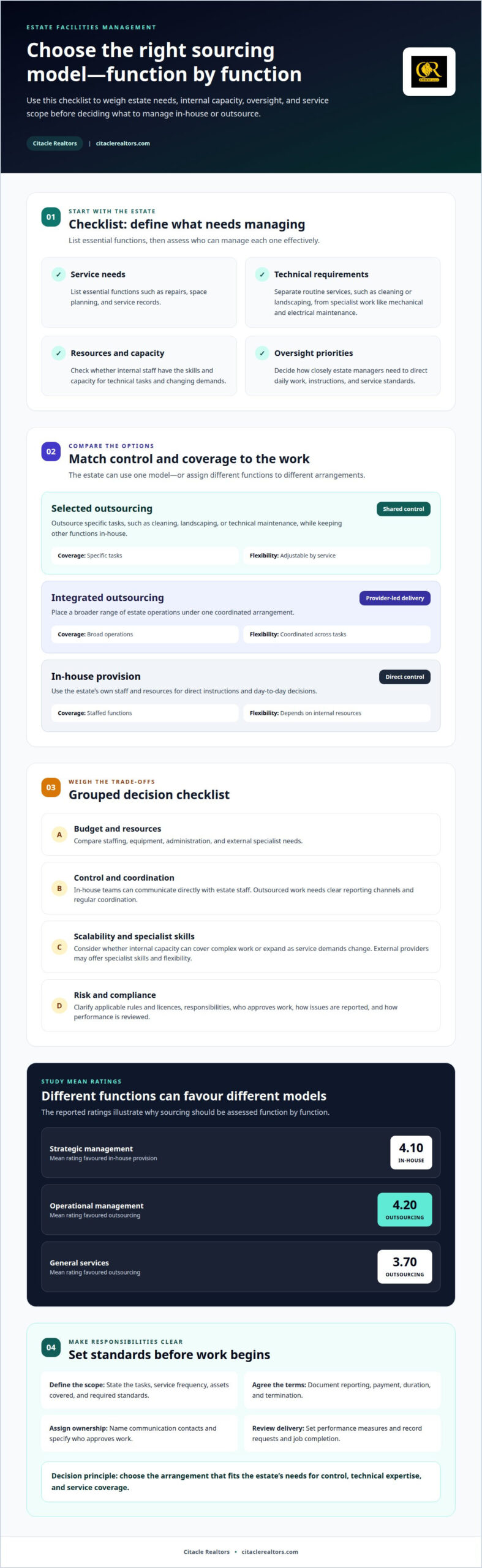
In-house provision relies on an estate’s own staff and resources, giving managers direct control over instructions and daily decisions. Outsourcing transfers agreed tasks to external providers, who may offer specialist skills and flexibility as needs change. An in-house team may communicate directly with estate staff; an outsourced arrangement needs clear reporting channels and regular coordination.
Risks include reduced oversight, unclear responsibilities, and service gaps when expectations are not documented. Specify who approves work, how issues are reported, and how performance is reviewed. For example, agreed reports can record maintenance requests and whether each job has been completed.
| Option | Control | Coverage | Flexibility |
|---|---|---|---|
| Selected outsourcing | Shared | Specific tasks | Adjustable by service |
| Integrated outsourcing | Provider-led delivery | Broad operations | Coordinated across tasks |
| In-house provision | Direct | Staffed functions | Depends on internal resources |
Choose the arrangement that fits the estate’s needs for control, technical expertise, and service coverage.
Developers should decide early: self-provide or outsource. The study’s general-services mean favoured outsourcing, at 3.70 points. In-house communication can speed responses and clarify instructions; external experts may raise costs, while scale economies and avoiding in-house staffing, equipment and infrastructure may lower costs.
A framework for choosing between outsourcing and in-house provision
Choose a sourcing model by weighing budget, control, estate requirements, scalability, risk tolerance, and compliance needs. When considering outsourcing facility management for estates, start by listing essential functions, such as repairs, space planning, and service records. Then assess who can manage each function effectively.
An in-house team can align daily decisions with estate priorities and respond directly to staff, but it also requires investment in personnel, equipment, and infrastructure. Specialist work may still need external contractors, adding coordination and expense. Limited internal skills or capacity can make complex issues harder to resolve and operations more difficult to expand.
- Budget: Compare staffing, equipment, administration, and external specialist needs.
- Control: Decide how closely estate managers must direct daily work and standards.
- Capacity: Identify technical tasks or changing demands that internal staff may struggle to cover.
In-house facilities management can suit estates that need direct supervision and have the right people and resources. Recruitment, training, and equipment remain internal responsibilities. Maintenance-tracking tools can help allocate work and keep records, but they do not replace the skills required to resolve technical problems.
A public-private partnership brings public and private parties together in a shared arrangement. Its responsibilities and decision-making structure differ from fully internal management or a direct external service contract. For outsourcing facility management for estates, define decision-making authority, service duties, reporting, and performance measures before choosing this approach.
A facilities management study’s mean ratings favoured in-house provision for strategic management, at 4.10 points, and outsourcing for operational management, at 4.20 points. The contrast shows why estates should assess each function separately rather than treat one sourcing model as suitable for every task.
When choosing a facilities management company in Nigeria, match its proposed scope to the estate’s tasks, technical requirements, reporting needs, and performance standards. Clearly assigned responsibilities and review measures help connect service delivery with estate priorities and core business.
For estate oversight that brings property and facilities responsibilities together, explore property and facilities management.
Maintenance, cleaning, security and energy management
Estate operations combine routine upkeep with specialist work across buildings. Before assigning tasks, define the required services, maintenance standards, and reporting process.
Facility Maintenance Outsourcing
Facility maintenance outsourcing assigns agreed repair and upkeep tasks to external specialists. Unlike cleaning or security, maintenance may involve building systems, equipment, and structural components. For example, an estate can outsource mechanical and electrical maintenance while managing cleaning separately.
Specify which assets are covered, how requests are recorded, and who approves repairs. A clear division of responsibilities helps prevent faults in shared spaces, such as a corridor light that has stopped working, from being overlooked.
Maintenance Consistency and Response
Consistent service depends on routine inspections, work records, and clear standards. Response also depends on how residents or staff report faults, how issues are prioritised, and how completion is documented. For example, a leaking pipe should have a traceable record from the first report through repair and close-out.
To monitor a provider’s performance, compare completed work orders and response records with the agreed service standards. Review recurring faults and resident feedback, then document any corrective actions agreed with the provider.
Cleaning, security, and energy management each need distinct checks. Cleaning records can show whether shared spaces receive the agreed attention, while security reports can document incidents and follow-up. Energy monitoring can help managers spot unusual consumption in common areas and investigate causes, such as equipment running unnecessarily.
Use a practical reporting routine to connect daily work with estate priorities. Review outstanding repairs, repeat faults, cleaning observations, security incidents, and energy-use patterns. These records provide a basis for discussing service quality, resident satisfaction, and potential savings with providers.
For example, if corridor lights keep failing, compare maintenance records with energy-use information and repair outcomes. This review can show whether the issue calls for a different repair approach, more consistent inspections, or updated service instructions.
Advantages of outsourcing facilities management
Outsourcing can give an estate access to technical expertise without requiring it to build every capability in-house. The benefits are greatest when assigned tasks match operational needs, such as entrusting complex equipment maintenance to specialists while estate managers focus on resident services and long-term priorities.
External providers may combine people, equipment, and purchasing needs across multiple properties. This scale can support more efficient access to materials and specialist services. For example, an estate facing changing maintenance demands can adjust the scope of assigned work rather than permanently expanding its own team. That flexibility can help management respond to renovations, seasonal pressures, or newly identified maintenance needs.
- Specialist expertise: Technical providers can handle complex building systems that require specific skills.
- Capacity: An estate can bring in support for a defined project without making every role permanent.
- Management focus: Delegating routine operations can leave estate staff more time for resident communication and planning.
- Service visibility: Agreed performance measures can make work completion and recurring issues easier to review.
These advantages depend on a clearly defined scope. If an agreement does not specify who approves work, reports faults, and reviews results, managers may lose visibility into daily service delivery. Repeated lift faults, for instance, need a clear record of reports, repairs, and follow-up, not just informal updates.
Outsourcing estate management can mean less direct control over how work is done. Communication may take longer when staff must report issues through an external team, and poor coordination can affect residents. Set service standards, reporting routines, escalation routes, and review meetings in the agreement, then assess performance against those commitments.
The practical takeaway is to outsource tasks where specialist capability or flexible capacity adds value, while retaining oversight of priorities and outcomes. Plan estate facilities management around the services, expertise, and level of control your property needs.
Citacle Realtors
Citacle Realtors can help estate owners connect facilities decisions with broader property oversight through its Property Management and Facilities Management services. These services can support the coordination of estate operations, maintenance priorities, and day-to-day property needs.
When weighing in-house staffing against outsourced support, consider the work your estate needs and the level of oversight you want to retain. Defining those priorities helps shape a practical management approach for the property and its residents.
Contact Citacle Realtors to discuss your estate’s management needs.
Make your estate’s next decision with confidence
The next step is to turn your estate’s priorities into a practical operating plan. Decide which outcomes matter most to residents and owners, then establish how you will review whether the chosen arrangement continues to meet those needs. A considered approach to outsourcing facility management for estates can adapt as property requirements change, rather than locking every decision into a fixed pattern.
Citacle Realtors offers Property Management, Facilities Management, and Residential Land Sales. If you are planning a new arrangement or refining how your estate is managed, contact Citacle Realtors to discuss your property’s needs and a suitable next step.
Contact Citacle Realtors to discuss your estate. With clear priorities and a thoughtful plan, you can move forward with greater confidence.
Frequently Asked Questions
What does outsourcing estate facility management involve?
Outsourcing means assigning agreed estate operations to an external provider while estate representatives retain the oversight set out in their arrangement. For example, a resident might report a faulty shared water pump to an estate contact, who logs the issue and routes it for action. A written scope should specify the reporting channel, approval responsibilities, work records, and escalation process so every request has a clear path.
Which facility management services can estates outsource?
Estates can outsource services such as cleaning, security, landscaping, refuse collection, building repairs, and mechanical or electrical maintenance. The right mix depends on the estate’s facilities and the capabilities of its existing team. For instance, management could handle resident communication in-house while outsourcing streetlight maintenance. Grouping tasks by function clarifies who handles each activity and how service records are shared.
How can an estate compare outsourced management with an in-house team?
Compare the full responsibilities of each option, not just how staff are engaged. If an estate has an internal caretaker, list the tasks they handle, then identify gaps in technical coverage, equipment, or work records. Compare those needs with an outsourced scope, including who supplies materials, approves repairs, and reports completion. This makes differences in accountability and day-to-day oversight easier to assess.
Which facility management companies serve residential estates in Nigeria?
Citacle Realtors is a Nigerian real estate firm providing Property Management and Facilities Management, including day-to-day facility operations. These services support property owners who need help overseeing estates and managing property needs. The firm also offers Residential Land Sales. For a residential estate, the management scope should reflect its operational needs and the responsibilities owners want handled.