

There’s no defined legal timeframe in Nigeria for a landlord to return a caution fee after a tenancy ends. In Lagos, 30 days from vacant possession is a good-practice timeframe, but it isn’t a precise deadline set by the Lagos State Tenancy Law 2011. The security deposit laws in Nigeria therefore leave tenants and landlords relying heavily on the tenancy agreement and clear records of the property’s condition.
It’s reasonable to expect your deposit back when you leave a property in good condition, and to ask for evidence if a landlord proposes deductions. A caution fee is meant to cover justified costs, not become an unexplained charge or a substitute for rent.
This guide explains the purpose of a caution fee, how refunds and damage deductions work, and what to do if there’s a dispute. Clear agreements, condition records, and communication can help both parties manage the process with confidence.
Key Takeaways
- In Lagos, 30 days from vacant possession is good practice for returning a caution fee, but the law sets no precise refund deadline.
- Learn how to distinguish damage beyond normal wear and tear from fair reasons to deduct money from a deposit.
- A written tenancy agreement and clear records of the property’s condition can help prevent misunderstandings about deductions and refunds.
- Understand when property management may help landlords oversee rental arrangements and support clearer communication with tenants.
Disputes over deductions and property damage
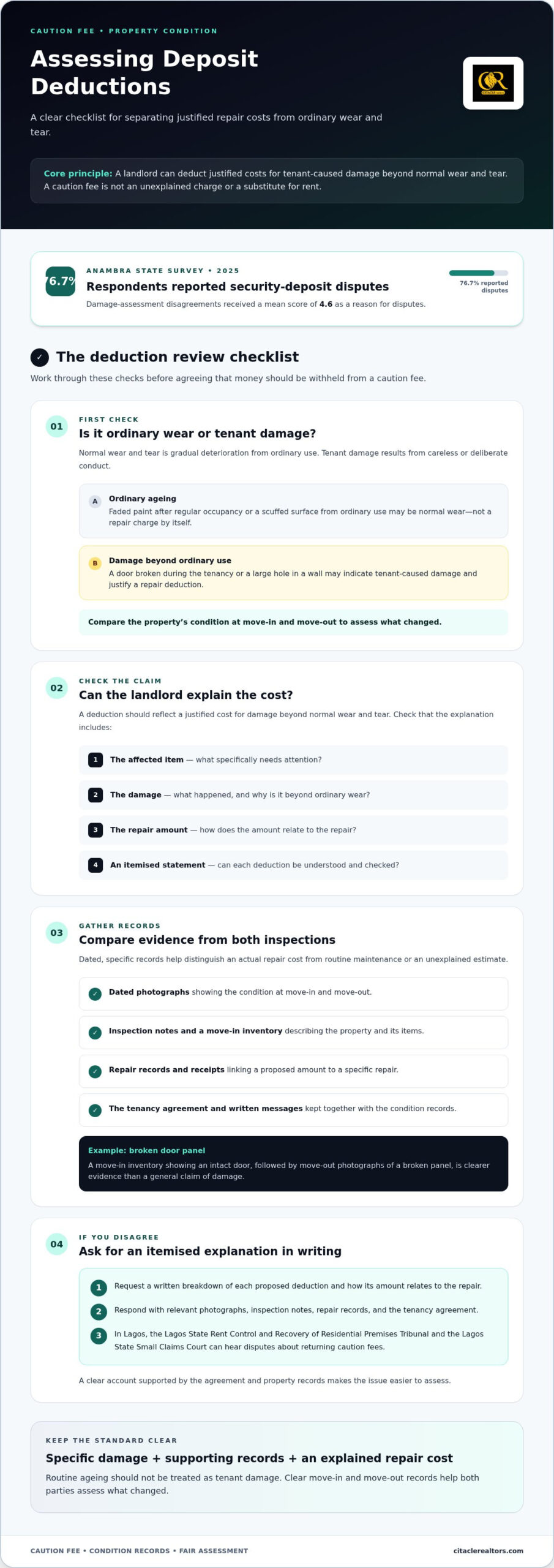
A landlord can deduct justified costs for tenant-caused damage beyond normal wear and tear. For example, a door broken during the tenancy may justify a repair deduction, but ordinary ageing does not.
In Anambra State, 76.7% of survey respondents reported security-deposit disputes in 2025. Damage-assessment disagreements received a mean score of 4.6 as a reason for disputes.
Wear and Tear Versus Tenant Damage
Normal wear and tear is gradual deterioration from ordinary use; tenant damage results from careless or deliberate conduct. Faded paint after regular occupancy, for instance, differs from a large hole in a wall. This distinction matters because tenants should not be charged for routine ageing. Comparing the property’s condition at move-in and move-out helps both parties assess what changed.
Permissible Deposit Deductions
A deduction should reflect a justified cost for damage beyond normal wear and tear. The landlord should identify the affected item, explain the damage, and show how the amount relates to the repair. A damaged door may justify a repair deduction, for example, while a scuffed surface from ordinary use may not. An itemised statement helps the tenant understand each deduction and challenge unsupported charges.
Tenants and landlords can compare dated photographs, inspection notes, and repair records to assess a claim. A move-in inventory showing an intact door, followed by move-out photographs of a broken panel, is clearer evidence than a general claim of damage. Keep receipts and written messages with the tenancy agreement. These records help distinguish an actual repair cost from routine maintenance or an unexplained estimate.
If you dispute a proposed deduction, request an itemised explanation in writing and respond with relevant condition records. The Lagos State Rent Control and Recovery of Residential Premises Tribunal and the Lagos State Small Claims Court can hear disputes about returning caution fees. A clear account supported by the agreement and property records makes the issue easier to assess.
How long should a Nigerian landlord take to return the caution fee?
Nigeria has no defined legal timeframe for returning a security deposit. Lagos State Tenancy Law 2011 sets no precise refund deadline, while 30 days from vacant possession is good practice in Lagos. Lagos, Abuja (FCT), and other states may follow different tenancy frameworks, so the applicable state law and written tenancy terms matter.
The laws governing rental deposits include state-specific tenancy laws rather than one uniform national refund procedure. Lagos State Tenancy Law 2011 and equivalent state laws recognise a caution fee as a security instrument, not a permanent charge. The fee is additional to advance rent and is refundable after justified deductions.
Nigerian landlords can request advance rent alongside a caution fee because they serve different purposes. In Lagos, the maximum advance rent for residential tenancies is one year under Lagos State Tenancy Law 2011. A caution fee is commonly one to two months’ rent, with no statutory cap; the amount should be agreed and recorded separately from rent.
Deposit amounts can be set by agreement, such as a fixed sum or a percentage of rent. In an Anambra State survey, 30% of respondents said they used a fixed percentage of rent in 2025. The study recommends legislation establishing a maximum deposit, custody protocols, and clear refund timelines. These proposed safeguards would address the amount collected and how landlords handle the money.
Until a clear refund procedure applies, the tenancy agreement can set practical terms. A sample deposit clause calls for an itemised deduction statement within thirty (30) days of vacant possession. In Lagos, 30 days is also described as good practice for returning the fee. If the landlord provides neither the refund nor an itemised statement, the tenant may send a written demand requesting return within 14 days.
Before payment, put the deposit amount, permitted deductions, and refund process in writing. These terms give both parties a clear reference when the tenancy ends.
Common challenges administering deposits
Deposit administration can become difficult when collection, record-keeping, and repayment lack clear procedures. An Anambra State survey found that 93% of respondents collected security deposits from tenants in 2025. Yet collection alone does not establish how the money will be tracked, assessed, or returned when a tenancy ends.
Custody creates another practical concern. The study reports no legal requirement in Nigeria for landlords to keep deposits in a separate account. In the Anambra survey, 58% of respondents said landlords held and managed deposits. Without a clear ledger, a landlord may struggle to distinguish a tenant’s deposit from other property income.
Refund delays can also damage the landlord-tenant relationship. In the Anambra survey, delayed refunds received a mean score of 4.0 as a reason for deposit disputes. A tenant who has returned the keys may still face uncertainty if the landlord hasn’t communicated the refund decision or explained outstanding deductions.
Timing disputes can arise even when both parties expect repayment. In the same survey, 61.6% of respondents said deposits were typically refunded within one month, while 24% reported waiting longer. These findings describe reported practices, not a uniform legal deadline. A written tenancy clause can set expectations about assessment, communication, and repayment.
Inconsistent assessments can create further disputes. One inspection may treat a stained wall as tenant damage, while another considers it ordinary deterioration. Dated move-in and move-out records, clear descriptions, and repair receipts help explain the decision. A written itemisation also lets tenants see whether each deduction relates to a specific, documented issue.
Landlords and tenants can reduce confusion by keeping the agreement, payment evidence, inspection notes, photographs, and refund correspondence together. The Anambra survey found that 84% of respondents believed deposits effectively protected landlords. Clear administration helps that protection operate fairly, while giving tenants a transparent account of the amount retained and the reason.
Purpose of rental security deposits
A rental security deposit safeguards the landlord against justified costs linked to tenant-caused damage. It also gives both parties a defined amount to assess when the tenancy ends. A broken fixture, for example, can be assessed against the property’s recorded condition rather than treated as an automatic loss of the entire deposit. Understanding security deposit laws in Nigeria helps landlords and tenants distinguish the deposit’s purpose from rent.
A deposit is not meant to cover ordinary ageing or payment for a future period of occupancy. A caution fee is a security instrument. Advance rent pays for use of the property, while the deposit addresses justified costs arising during the tenancy. Keeping the amounts separate makes the agreement easier to understand.
For landlords, a deposit can encourage care and provide funds for justified repair costs. For tenants, its refundable nature means the money can be returned after the tenancy, less justified deductions. The landlord should link each proposed deduction to a specific issue, such as a damaged fixture, rather than apply a broad charge without explanation.
The property’s move-in condition matters when assessing the deposit. Before possession, both parties can record existing marks, worn fittings, and working appliances in an inventory. At move-out, they can compare that record with the property’s condition. A crack documented at move-in, for example, should be distinguished from damage that arose during the tenancy. These records support fair application of security deposit laws in Nigeria.
A clear agreement helps the deposit serve its intended purpose. It can state the amount, define justified deductions, and explain how the final assessment will be communicated. Without those terms, a tenant may expect automatic repayment while a landlord anticipates deductions, even if both believe they have acted fairly.
Before signing, separate the caution fee from rent in the written agreement and keep proof of payment. If you’re considering a rental, explore duplex rental options with the deposit terms in mind.
Citacle Realtors: Property Management
Citacle Realtors provides Property Management for owners who need support overseeing rental properties and tenant arrangements. Professional oversight can help organise tenancy records, property condition documentation, and communication about move-in and move-out matters.
Good management keeps the property and its tenancy documentation in view, including condition records that help explain deposit decisions. This supports orderly administration for landlords. For tenants, clear terms and documented expectations make responsibilities easier to understand from the outset.
If you’re considering professional oversight for a rental property, contact Citacle Realtors to discuss Property Management.
Make your next property decision with clarity
Use your understanding of security deposit laws in Nigeria to clarify rental expectations before a tenancy begins. A written agreement, careful records, and open communication can support a more orderly relationship between landlord and tenant. For property owners, thoughtful oversight can also help organise tenancy administration and broader property responsibilities.
Citacle Realtors also offers Facilities Management and Residential Land Sales. Whether you’re considering how to oversee a property or planning a real estate transaction, choose a next step that fits your needs and priorities.
Explore Citacle Realtors’ property services and take your next step with confidence.
Frequently Asked Questions
If refunded, how long does it typically take?
There is no nationally defined legal refund period. Timing often depends on the final inspection and whether repair costs or bills remain unresolved. For example, Lagos post-paid electricity bills may take 2-4 weeks to reconcile after meter readings are submitted, affecting the final account. A written agreement can clarify when the review begins and how the refund will be handled.
What are the common reasons for disputes?
Disputes often concern damage assessments, unclear deductions, and delayed refunds. A vague explanation such as “repairs” does not identify the damaged item or explain how the cost was calculated. Request an itemised explanation, then compare each claim with the tenancy terms and available records. Unresolved utility balances can also complicate the final settlement between landlord and tenant.
What happens if there is no check-in inventory and the landlord claims damage?
Without a check-in inventory, there are fewer shared records for comparing the property’s condition at the beginning and end of the tenancy. Gather dated photographs, messages reporting existing defects, maintenance requests, and relevant receipts. The landlord should identify the specific damage and explain the proposed repair cost. Consider all available evidence together; a missing inventory is not proof of damage.
Is there a legal limit on how much a landlord can demand as a security deposit in Nigeria?
The information covered here states no statutory cap on the caution fee. The fee commonly amounts to one to two months’ rent, but this is not a legal maximum. Agree on the amount before payment and record it separately from advance rent in the tenancy agreement. The written terms should also explain how the deposit will be assessed and returned.
When must a landlord return a security deposit in Nigeria, and are there statutory deadlines?
Nigeria has no defined legal timeframe for returning security deposits. Lagos State Tenancy Law 2011 doesn’t specify a precise number of days for a caution-fee refund; 30 days from vacant possession is described as good practice in Lagos. The tenancy agreement can set a clear process for reviewing the property, explaining deductions, and communicating the refund decision.
Can a landlord withhold a deposit for unpaid rent, damage, or ordinary wear and tear in Nigeria?
A landlord may retain justified deductions, but the reason should be clear and supported by records. Damage beyond normal wear and tear can justify a deduction; ordinary ageing alone cannot. For claimed unpaid rent, compare the rent ledger with payment receipts and the tenancy terms. Request separate calculations for rent arrears and repair costs so each claim can be assessed clearly.