

Rental income from Nigerian property is taxable income under the Nigeria Tax Act 2025, scheduled to take effect from January 1, 2026. The tax implications of rental income in Nigeria depend on the income earned and the landlord’s circumstances, with qualifying expenses potentially reducing the amount subject to tax.
If you own rental property in Nigeria, it’s reasonable to ask whether tax applies to rent you collect, which costs may be deductible, and whether living abroad changes your obligations. The key distinction is that rent received by a landlord is different from rent relief available to an individual who pays rent.
This guide explains how rental income is treated, which expenses may count, how personal income tax rates apply, and why residency can matter. It outlines the rules for Nigerian property and the factors that shape the tax treatment of rental income.
Key Takeaways
- Rental income from Nigerian property is taxable, but qualifying expenses incurred to earn that income may reduce the taxable amount.
- From January 1, 2026, individuals may claim rent relief equal to 20% of annual rent paid, capped at ₦500,000 per year.
- Keep clear records of rent received and eligible costs, and distinguish routine repairs from major improvements when working out taxable rental income.
- Personal income tax rates depend on total income; under the new rules, individual property profits are taxed at progressive rates up to 25%.
- Residency can affect tax treatment: spending 183 days or more in Nigeria within any 12-month period is one factor in determining Nigerian tax residency.
Is rental income from property in Nigeria taxable?
Yes. Rent earned from Nigerian property is taxable income under the Nigeria Tax Act 2025, which took effect on January 1, 2026. This applies to landlords receiving rent from residential or commercial property. Rent relief is a separate measure for individuals who pay for their own residential housing; it does not exempt a landlord’s rental income.
From January 1, 2026, an individual may claim relief equal to 20% of annual rent paid, up to ₦500,000 per year. The relief applies to employees under PAYE and self-employed individuals under Personal Income Tax. Rent paid for business premises does not qualify for this personal housing relief.
The calculation uses the rent the individual pays, not the rent a landlord collects. For annual rent of ₦1,200,000, 20% equals ₦240,000, below the ₦500,000 cap. For annual rent of ₦3,000,000, 20% equals ₦600,000, so the claim is limited to ₦500,000. Annual rent of ₦400,000 produces relief of ₦80,000.
Keep records that connect the claimant to the home and the rent paid. From 2026, a Tax Identification Number is required to claim rent relief. Retain rent receipts issued in your name and an active, properly dated tenancy agreement. These documents support the amount claimed and show that the accommodation is residential rather than business premises.
Owner-occupiers have a distinct deduction. Section 30(2)(a)(iv) of Nigeria’s tax law allows an individual to deduct interest on a loan used to develop an owner-occupied residential house. This is not the same as rent relief: it concerns qualifying loan interest and a home the individual occupies, rather than rent paid to a landlord.
Failing to declare or pay rental income tax can lead to penalties, interest charges, and legal disputes. Property owners across the country must also keep accurate rental-income and expense records and file annual returns.
The relevant tax authority depends on where the owner’s tax obligations are administered. Across the nation, the appropriate state internal revenue service handles the process, and property owners must obtain a Tax Identification Number from their local tax authority before paying rental income tax.
Keep the two calculations separate: rent relief concerns eligible rent you pay for residential accommodation, while rental income tax concerns rent you receive as a landlord. Identifying the right category and retaining the relevant tenancy, receipt, and income records helps you report each amount accurately with guidance from Citacle Realtors.
Taxation of rental income from Nigerian property
Taxable rental income is generally calculated by deducting eligible costs from rent received. For property owners, it is important to distinguish operating expenses from capital improvements.
Non-resident property owners
A non-resident property owner owns Nigerian property while living outside Nigeria. Consider rental income and residency separately: a person’s residence does not, by itself, determine how rent from Nigerian property is treated.
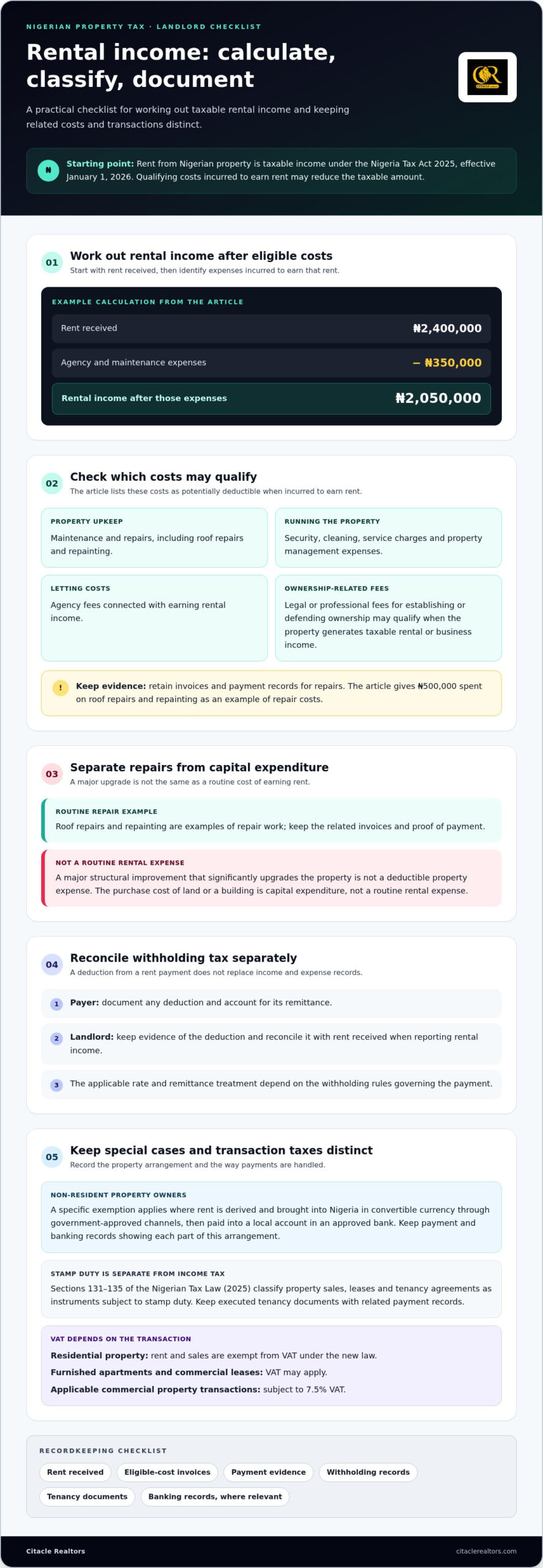
A specific exemption applies where rent is derived and brought into Nigeria in convertible currency through government-approved channels, then paid into a local account in an approved bank. Keep payment and banking records showing each part of this arrangement. Residency status can also affect an individual’s wider tax position, so record where income arises and how it is received.
Withholding tax on rent
Withholding tax on rent is deducted from a payment and is distinct from calculating the landlord’s taxable rental income. If a tenant deducts an amount, the tenant should retain payment and deduction records, while the landlord should reconcile them with rent received.
The applicable rate and remittance treatment depend on the withholding rules governing the payment. The payer making a deduction should document it and account for remittance; the landlord should retain evidence when reporting rental income. A withheld amount does not replace the need to keep income and expense records.
For example, a landlord receiving ₦2,400,000 and incurring ₦350,000 in agency and maintenance expenses has ₦2,050,000 in rental income after those expenses. Maintenance, repairs, agency fees, security, cleaning, service charges, and property management expenses may be deductible when incurred to earn rent.
Keep invoices and payment evidence for repairs. An example includes ₦500,000 spent on roof repairs and repainting. By contrast, a major structural improvement that significantly upgrades the property is not a deductible property expense. The purchase cost of land or a building is capital expenditure, not a routine rental expense. Legal or professional fees for establishing or defending ownership may be deductible when the property generates taxable rental or business income.
Stamp duty is a separate issue from income tax. Sections 131-135 of the Nigerian Tax Law (2025) classify property sales, leases, and tenancy agreements as instruments subject to stamp duty. Keep executed tenancy documents with the related payment records.
VAT treatment depends on the transaction. Residential property rent and sales are exempt from VAT under the new law. VAT may apply to furnished apartments and commercial leases; applicable commercial property transactions are subject to 7.5% VAT. Residential and commercial arrangements should therefore be recorded distinctly, rather than grouped under one description.
Tax treatment of rental income in Nigeria
The tax calculation depends on whether the property owner is an individual or an entity. Under the Nigeria Tax Act 2025, taxable rental income is considered alongside the applicable expenses and the owner’s wider income position.
Personal income tax treatment
For individuals, rental income is assessed within the personal income tax system. The applicable rate depends on the individual’s total income, not on rent viewed in isolation.
Start with rent received, then account for reasonable expenses incurred to earn that rent. Keep records that distinguish rental receipts from other personal income and support each expense claimed. For instance, a landlord’s records should identify which property generated the rent and connect maintenance or agency costs to that income. The Nigeria Tax Act 2025 governs the property deductions discussed here.
Do not treat the purchase price of a building or land as a routine rental expense. Buying land or a building is capital expenditure, while eligible costs relate to earning taxable income. This distinction helps individuals separate acquiring a property from its ongoing rental activity.
Company rental income taxation
For companies, rental income forms part of the entity’s income considered for tax purposes. The applicable tax rate depends on the company’s total income, so there is no single rental-income rate to apply without considering the wider calculation.
How is rental income taxed for companies in Nigeria? It is assessed as part of the company’s total income, and the treatment depends on the entity’s income position. A business may deduct rent for an office or shop used wholly for business when calculating company profits. Keep the lease and payment records linked to the premises and their business use.
Company records should distinguish rental receipts from rent paid for occupied premises. For example, a consulting firm’s office rent is different from rent the company earns by letting a property. Clear accounting descriptions help keep the transactions separate when calculating income.
Personal tax rates on rent
For individuals, property profits fall under personal income tax rates up to 25% under the new rules. Section 58 of the Nigeria Tax Act sets the first ₦800,000 of taxable income at 0%.
The rate applied to an individual’s rental income depends on total taxable income and the applicable progressive bands. Do not automatically multiply gross rent by the top rate. First calculate taxable rental profit, then consider it within the individual’s wider income calculation.
For example, someone earning rent from several properties should keep a separate income and expense record for each one. Then combine the relevant taxable figures with other income for the overall assessment. This makes it easier to understand how rental profits affect the individual’s tax position.
January 1, 2026 marks the effective date of the Nigeria Tax Act 2025. For an annual calculation, retain records covering the relevant income period, including rent received, eligible expenses, and supporting documents. Accurate classifications help distinguish personal rental activity from company income and prevent capital costs from being treated as ordinary expenses.
Rental income as taxable income in Nigeria
Under the Nigeria Tax Act 2025, rent from property is treated as income, not as proceeds from selling property. For landlords, the tax implications of rental income in Nigeria begin with distinguishing gross rent from taxable profit. That difference matters because qualifying expenses can reduce the amount assessed, while capital costs and major improvements are treated differently.
Start by recording the rent received during the relevant income period. Rental income may come from residential property, commercial space, or vacation rentals. Then identify reasonable costs incurred to earn that rent and retain supporting records. For example, a landlord receiving ₦3,000,000 and spending ₦500,000 on qualifying roof repairs and repainting calculates taxable income after accounting for those expenses.
Classify each payment carefully. Maintenance, repairs, agency fees, security, cleaning, service charges, and property management expenses may be deductible when they relate to earning rent. A major structural improvement that upgrades the property is not a deductible property expense under the 2025 rules. The purchase cost of land or a building is capital expenditure, not a routine expense against rental income.
Keep invoices and payment evidence linking each cost to the property and its rental activity. Legal and professional fees for establishing or defending ownership may be deductible when the property generates taxable rental or business income. The tax implications of rental income in Nigeria therefore depend partly on whether a payment supports current rental operations or relates to acquiring or substantially improving an asset.
For individuals, rental profit is considered within the personal income tax structure, where the rate depends on total income. Under the new rules, individual property profits are taxed at progressive rates up to 25%. Section 58 of the Nigeria Tax Act sets the first ₦800,000 of taxable income at 0%. This means the highest rate is not automatically applied to all gross rent.
Residency is another consideration for an individual’s overall Nigerian tax position. A person spending 183 days or more in Nigeria within any 12-month period is considered a Nigerian tax resident. A year-round rented property available to that person may qualify as a permanent home for tax-residency purposes. Record residence details separately from property ownership and rental receipts.
For companies, rental receipts are considered alongside total income. A business may deduct rent for premises used wholly for business when calculating company profits. Keep separate records for rent earned from property and rent paid for the company’s own premises. This helps clarify the company’s income calculation.
The practical approach is to identify rent received, classify related expenses, and calculate taxable rental profit before applying the relevant tax treatment. The Nigeria Tax Act 2025 took effect on January 1, 2026; complete records help explain how each amount was treated.
What personal income tax rates apply to rental income in Nigeria?
For an individual landlord, rental profit is taxed within the personal income tax structure. Under the new Nigerian rules, individual property profits are taxed at progressive rates up to 25%. The rate is determined by total income, so the top rate does not automatically apply to every naira of rent collected.
Section 58 of the Nigeria Tax Act sets the first ₦800,000 of taxable income at 0%. This is the starting point for understanding how the progressive structure works. A landlord calculates taxable rental profit after eligible expenses, then considers that profit alongside other taxable income. Gross rent alone does not show the final tax position.
For example, an individual with taxable income within that first ₦800,000 band has that portion taxed at 0%. If rental profit and other income take total taxable income above that threshold, the applicable progressive rates determine the treatment of the additional income. The available figures establish the starting band and maximum rate, not every intermediate band.
This distinction matters for landlords with employment income or other taxable earnings. A person earning a salary and collecting rent should consider both sources in the overall personal income calculation. Applying 25% to rental receipts alone could produce a misleading estimate because it ignores eligible expenses and the individual’s total income.
For each property, record rent received, subtract qualifying expenses, and retain evidence for each amount. Keep the resulting rental profit distinct from other income before calculating an individual’s overall taxable income. Repair invoices and rent receipts help support the figures in that calculation.
Rent relief is a separate provision for individuals who pay rent for residential accommodation. It does not reduce a landlord’s rental income simply because the landlord also pays rent elsewhere. From January 1, 2026, qualifying individuals may claim relief equal to 20% of annual rent paid, capped at ₦500,000 per year. Keep the rent-relief claim separate from rental-profit calculations.
For instance, the 25% rate is the maximum stated rate for individual property profits under the new rules, not a flat rate on every rental payment. Section 58’s 0% treatment for the first ₦800,000 also shows why taxable income and gross receipts must not be confused. The taxable amount, other income, qualifying expenses, and applicable bands all affect the final calculation.
Use the rate structure as a framework, not a shortcut: calculate profit first, combine it with other taxable income, and apply the progressive rules. This keeps rent, deductible costs, and personal income in their proper places.
Citacle Realtors: Property Management
Citacle Realtors offers Property Management for owners who need support overseeing rental property and its day-to-day requirements. It can help when coordinating property oversight and maintenance alongside tax records becomes difficult.
Keeping rental income and property expenses organised can make it easier to prepare the information needed for tax reporting. Citacle Realtors also offers Facilities Management, Residential Land Sales, and Duplex Rentals, connecting property oversight with broader real estate needs.
To discuss managing a rental property, contact Citacle Realtors and take the next step.
Make your next property decision with clarity
Good property decisions begin before the next tenancy or acquisition. Create a consistent way to track rent, property documents, and maintenance activity, then use that information when reviewing your plans. A clear recordkeeping routine can support informed conversations about ownership and oversight.
The tax implications of rental income in Nigeria are one part of managing a property with care. Your next step may be improving how an existing asset is overseen, coordinating its facilities, or exploring a future residential land purchase. Citacle Realtors offers Property Management, Facilities Management, and Residential Land Sales to support these real estate needs.
For property advice shaped around your plans, contact Citacle Realtors for property advice. A thoughtful next step can help you move forward with greater confidence.
Frequently Asked Questions
Who does this Tax Act apply to?
The Nigeria Tax Act 2025 applies to the tax treatment of rental income earned by individuals and companies. If you receive rent from property in Nigeria, the owner’s legal structure affects how the income is assessed. For example, an individual landlord considers rental profit within personal income tax, while a company considers rental receipts alongside its total income. Keep ownership and income records under the correct taxpayer’s name.
Who is considered a Nigerian tax resident?
A person spending 183 days or more in Nigeria within any 12-month period is considered a Nigerian tax resident. A year-round rented property available to someone in Nigeria may also qualify as a permanent home for tax-residency purposes. For example, a person who owns rental property abroad but lives in Nigeria should distinguish residence indicators from the location where each income stream arises.
Why Does This Matter?
Residency matters because it can affect how an individual’s income is considered for Nigerian tax purposes. For a landlord living abroad, the property’s location in Nigeria and the owner’s residence are separate facts to document. Keep rental statements, ownership records, and evidence of where you live. These details help explain your circumstances when assessing income from Nigerian property alongside income earned elsewhere.
How is rental income taxed in Nigeria for individuals?
For an individual, taxable rental profit is considered within the personal income tax structure, where the applicable rate depends on total income. For example, a landlord with salary income and rent should consider both when calculating taxable income, rather than applying a rate to rent alone. Keep property income and expense records separate from employment documents so each figure is easy to identify.
Are rental expenses and repairs deductible from rental income in Nigeria?
Reasonable expenses incurred to earn rent may reduce taxable rental income. Examples include maintenance, repairs, agency fees, security, cleaning, service charges, and property management expenses. Keep invoices and payment evidence that connect each cost to the rental activity. A routine roof repair differs from a major structural improvement that upgrades the property; the latter is not deductible as a property expense under the 2025 rules.
When and how must landlords file and pay tax on rental income in Nigeria?
In Ogun State, property owners must file annual tax returns that include rental income, expenses, and taxes paid. They must also maintain accurate records and obtain a Tax Identification Number from OGIRS before paying rental income tax. Keep a yearly schedule of rent receipts and supporting expense documents. Filing deadlines and administration can depend on the relevant state tax authority.
Are rental income, leases, or tenancy agreements subject to VAT or stamp duty in Nigeria?
Residential property rent is exempt from VAT under the new law, while VAT may apply to furnished apartments and commercial leases. Applicable commercial property transactions carry 7.5% VAT. Separately, sections 131-135 of the Nigerian Tax Law (2025) classify property sales, leases, and tenancy agreements as instruments subject to stamp duty. Keep executed agreements with related rental and payment records.
How are rental income taxes treated for non-resident landlords and foreign property owners in Nigeria?
Non-resident owners receiving rent from Nigerian property should distinguish the property’s location from their personal tax residence. Rent derived and brought into Nigeria in convertible currency through government-approved channels, then paid into a local account in an approved bank, is exempt from Nigerian tax. Keep evidence of the currency, transfer route, and receiving account to show whether this specific exemption applies to the rental receipts.